


Fraud Detection vs AML Monitoring: What's the Difference?
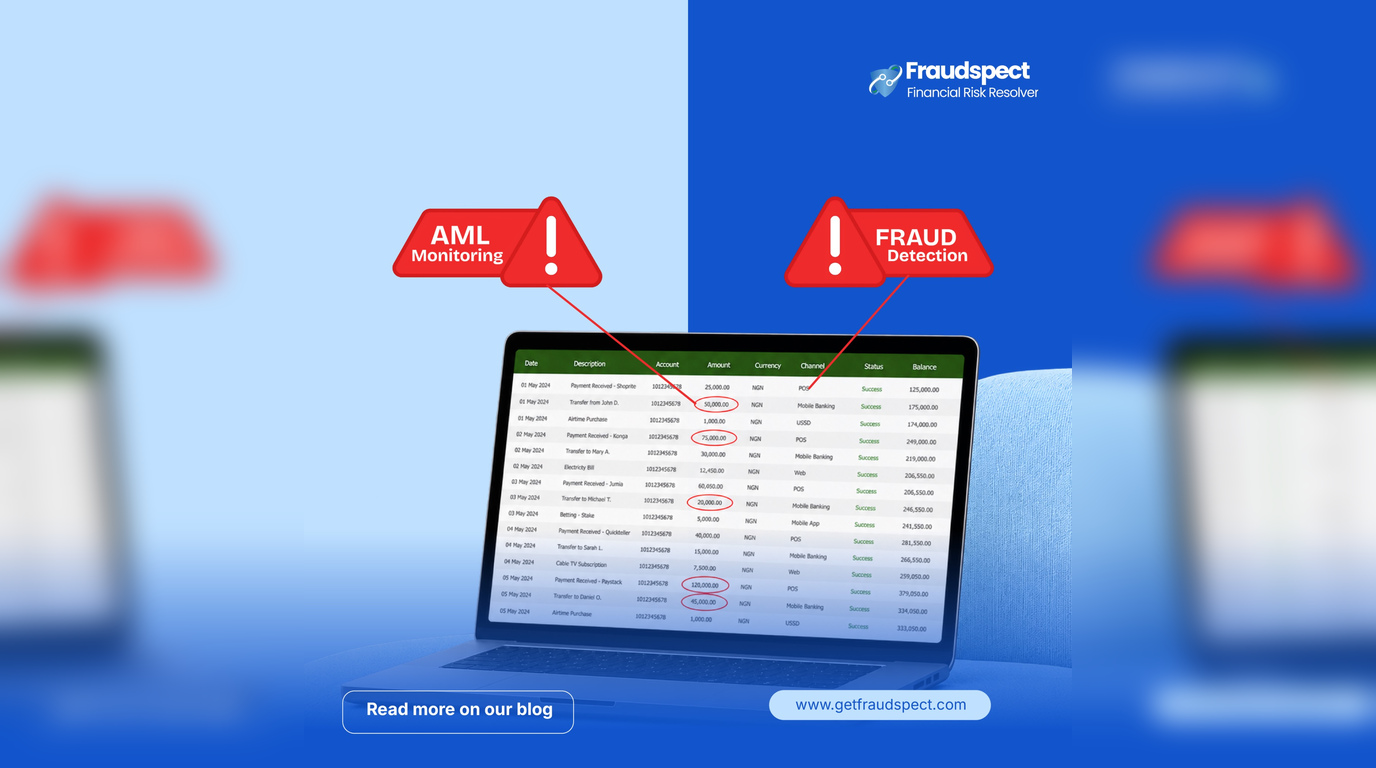
Fraud detection and AML monitoring answer different questions. This article explains where they overlap and why connecting both gives teams a clearer view of customer risk and activity.
Fraudspect Intelligence · 2026 Edition
If your fraud team and your AML team still run separate case queues at a Nigerian bank or fintech, the CBN's AML/CFT Baseline Standards for Automated Solutions, issued 10 March 2026 under circular BSD/DIR/PUB/LAB/019/002, already treat that separation as a weakness.
Standard 5.2 requires your monitoring system to link back to the same customer risk profile your onboarding team built. An examiner will not accept two disconnected systems as proof that the link exists.
Fraud detection and AML monitoring answer different questions. But at a Nigerian institution running compliance with three analysts covering work built for twelve, treating them as unrelated disciplines is exactly how gaps open.
By the end of this piece, you will know where fraud detection stops and AML monitoring starts, where the two overlap in a typical Nigerian KYC stack, and which one your examiner is actually testing when they pull a random alert from eight months ago.
What Fraud Detection Actually Does
Fraud detection exists to stop money from leaving the institution, the customer, or a merchant through deception. It is built for speed, and its success is measured in losses avoided, not paperwork filed.
A fraud system looks at a single transaction or session and decides, usually in under a second, whether it looks like the account holder or like someone else. That decision has to happen before the transfer clears or the card charge settles, because once the money moves, recovery odds fall fast.
A typical Nigerian fraud stack watches for:
- Device and SIM changes that don't match the customer's history, including the BVN-linked phone number swaps, are now restricted to once per lifetime from 1 May 2026
- Velocity spikes, several transactions in minutes from an account that normally moves money weekly
- Location mismatches between the registered address and the transaction origin
- Behavioural anomalies at login, unusual typing patterns, new devices, failed authentication attempts
- POS and agent-banking patterns tied to known cash-out and collusion typologies
None of this cares whether the money is dirty. It cares whether the person authorising the transaction is who they claim to be.
What AML Monitoring Actually Does
AML monitoring exists to detect the movement of illicit proceeds through the financial system, regardless of who initiated the transaction or whether it was authorised correctly. It works over days, weeks, or months, not seconds.
Where fraud detection asks "is this really you," AML monitoring asks "does this pattern of activity make sense for who you say you are?" A retail customer with a declared salary of ₦400,000 a month who suddenly receives twenty separate transfers just under the CTR threshold in a week is not committing fraud.
Nobody stole their identity. But the pattern fits structuring, and it demands a Suspicious Transaction Report to the NFIU.
A typical AML monitoring rule set in a Nigerian institution covers:
- Structuring detection, multiple transactions kept just under NGN 5,000,000 for individuals or NGN 10,000,000 for corporates to avoid triggering a Currency Transaction Report
- Layering patterns across accounts and counterparties over an extended lookback period
- Sanctions and PEP screening against updated watchlists, run continuously rather than only at onboarding
- Source-of-funds mismatches between declared income and transaction volume
- Cross-border corridor activity into jurisdictions that draw correspondent banking scrutiny, particularly the UK, US, and UAE
The output of AML monitoring is evidence for a filing, not a blocked transaction.
The Core Differences, Side by Side
| Category | Fraud Detection | AML Monitoring |
|---|---|---|
| Core question | Is this really the account holder? | Does this activity fit who they say they are? |
| Time horizon | Seconds to hours | Days to months |
| Legal basis | Institutional policy, contract law | Money Laundering (Prevention and Prohibition) Act 2022 |
| Primary output | Blocked transaction, step-up authentication | Suspicious Transaction Report to the NFIU |
| Success metric | Losses avoided, false positive rate at checkout | STR quality, alert-to-filing conversion, evidence trail |
| Who owns it | Risk and fraud operations | MLRO and compliance |
| Failure mode | Chargebacks, account takeover losses | Regulatory finding, CBN sanction |
Why Nigerian Institutions Can't Afford to Keep Them Separate
The gap between these two disciplines is where losses actually happen. NIBSS data presented at the 2026 Nigeria Electronic Fraud Forum put electronic payment fraud losses at ₦25.85 billion in 2025, down 51% from ₦52.26 billion in 2024, with reported incidents falling to 67,518 from a 2021 peak of 123,918. Lagos alone accounted for 63.43% of that activity.
That improvement is real, but it came from institutions that stopped treating fraud and AML as two teams reading two dashboards.
NIBSS Managing Director Premier Oiwoh told the forum that insider involvement remains the biggest threat behind the numbers, which is precisely the kind of pattern that only shows up when fraud signals and AML behavioural data sit in the same view.
The CBN has already shown it will penalise institutions that don't close this gap.
"In addition to these penalties, the banks are required to address the root causes of the lapses, which is crucial for improving regulatory effectiveness. Historically, the industry has struggled with recurring issues, but we are confident that this approach will help change that narrative."
— Olayemi Cardoso, CBN Governor, at the 2024 CIBN Bankers' Night, where the CBN disclosed ₦15 billion in combined fines across 29 banks for AML and CTF violations
Root causes, in nearly every one of those cases, traced back to weak transaction monitoring and incomplete customer due diligence records sitting apart from each other rather than a single, missing control.
Where Fraud Detection and AML Monitoring Overlap in a Nigerian KYC Stack
The two disciplines share a foundation even where their outputs diverge. Get this foundation wrong, and both systems fail on the same bad data.
- BVN validation against the NIBSS database and NIN verification against the NIMC feed both contribute to fraud scoring and AML customer risk assessment from the same onboarding event
- The Person of Interest Portal, jointly run by NIBSS, the CBN, and security agencies, now carries 13,417 flagged individuals used by both fraud and compliance teams to screen new accounts
- Liveness capture at onboarding closes the same synthetic-identity gap that both fraud losses and money laundering typologies exploit
- Case management, when unified, lets an AML investigator see whether an account already has a fraud flag before deciding whether a pattern is structuring or something else entirely
This is the linkage the CBN Baseline Standards demand under Standard 5.2, and it's also the fastest way to cut the four-minutes-per-alert grind that under-resourced Nigerian compliance teams describe when their monitoring and fraud tools don't talk to each other.
What This Means for Your Next CBN Examination
Nigeria's exit from the FATF grey list on 24 October 2025 raised the country's international standing, but it did not lower the CBN's own bar. If anything, examiners are watching more closely to protect that status. From 1 January 2026, SCUML stopped accepting CTR and CBTR filings by email, routing every DNFBP report through its portal, which means your evidence trail now has to be as auditable as your detection logic.
Before your next examination, confirm you can answer these without pulling in a colleague who left the institution months ago:
- Can you show which system flagged a given alert, fraud or AML, and why
- Can you produce the customer risk profile that fed the monitoring decision, not just the alert itself
- Can you trace a filed STR back to the transaction monitoring rule that triggered it
- Are your sanctions and PEP screening running daily against updated lists, not just at onboarding
- Does your fraud team's device and identity data reach your AML case files, or do the two live in separate exports
If more than one of those has a shaky answer, the gap between fraud detection and AML monitoring is where your next finding is going to come from.
How Fraudspect Brings Both Under One System
We built Fraudspect because we watched too many Nigerian institutions run fraud and AML as parallel tracks that only met inside a spreadsheet, weeks after the pattern that mattered had already passed.
Our platform runs transaction monitoring and AML compliance on the same customer record used by KYC verification and ID liveness at onboarding, so a fraud signal from last week's login attempt is already sitting in front of the analyst reviewing this week's structuring alert.
PEP and sanctions screening and adverse media screening run continuously rather than at onboarding only, and every decision, fraud or AML, lands in one audit trail an examiner can actually follow.
Across the more than 1 million transactions screened on the platform, decisions return in under 200ms at 98.4% detection accuracy, which matters when the same system is doing both jobs at once.
This does not remove your institution's accountability. The CBN holds the institution responsible regardless of which vendor sits underneath, and nothing here replaces your own risk assessment or your counsel's read on a specific case.
Start by mapping your current monitoring rules against the CBN's 12 Baseline Standards and flagging which ones have no evidence trail behind them.
If that exercise turns up more gaps than you'd like, book a Fraudspect demo, and we'll walk through what a single fraud and AML view looks like on your own transaction data.
Fraud Detection and AML Monitoring Need to Work Together
Fraud detection looks at whether an activity is genuinely coming from the customer, while AML monitoring looks at whether that activity makes sense based on the customer's profile and history. Keeping both disconnected can leave important signals in separate systems. Connecting them gives risk and compliance teams more context when reviewing alerts and making decisions.