
AML Compliance
What is anti-money laundering (AML)?
Money laundering allows criminals to disguise illegal funds as legitimate income. Discover how it works, the three stages involved, and the AML controls financial institutions use to detect suspicious activity.
Fraudspect Intelligence · 2026 Edition
Somewhere between $800 billion and $2 trillion is laundered every year. That's the United Nations Office on Drugs and Crime estimate, and it works out at 2 to 5 per cent of everything the world economy produces.
Almost none of it looks like crime while it's moving. It looks like a restaurant with good takings, a property sale, an invoice for consulting work, a transfer from a cousin. That's the whole point. Laundering is the business of making criminal money look ordinary, and ordinary is very hard to spot.
Anti-money laundering, or AML, is the set of checks financial institutions run to find that money even when it looks normal.
If you work in a bank, a fintech, a lender or a payment company, these checks are not optional. They're written into law in most countries, and the people who run them can be held personally responsible when they fail.
This article covers what AML actually is, how laundering works in practice, the main types you'll encounter, what a working AML programme contains, and where to start if you're building one. We've written it in plain terms, so no prior compliance background is needed.
What does anti-money laundering mean?
Anti-money laundering refers to the laws, rules, and internal controls that prevent criminals from turning illegal money into money they can spend openly.
The crime it targets was defined in the 1988 UN Vienna Convention as converting or transferring property, knowing it came from an offence, to conceal or disguise its origin, or to help someone involved escape the consequences.
In plain terms, somebody made money from crime and is trying to make it look like they earned it legally.
AML is what institutions do to prevent that from happening through their systems. It includes checking who customers are, watching what they do, screening them against official lists, and telling the authorities when something looks wrong.
AML deals with money that comes from crime. Terrorism financing works the other way round. The money is being gathered to pay for an attack, and it often starts perfectly legal, from a salary, a business or a donation. The controls for this are called CFT, or countering the financing of terrorism.
How does money laundering actually work?
Laundering runs in three stages. The United Nations Office on Drugs and Crime (UNODC) uses this model, and so does almost every regulator, because it describes what criminals genuinely do.
Stage one: placement
This is getting the money into the financial system, and it's the riskiest part for the criminal.
Cash is what makes this stage difficult for the criminal. A large amount of it has to enter a bank account somewhere, and that deposit is the most visible moment in the whole process.
To get around it, they break the money into smaller amounts, spread the deposits across several accounts, pay it into businesses that handle a lot of cash anyway, or carry it across a border.
Breaking a large sum into smaller deposits to stay under reporting limits has a name: ‘structuring', or ‘smurfing’. If you see a pattern of deposits sitting just below a threshold, that's not a coincidence. Nobody structures their money by accident.
Stage two: layering
Once the money is inside the system, the goal is to make its path impossible to follow.
The money gets moved repeatedly. It goes between accounts, then between banks, then across borders. It passes through companies, in and out of investments, and gets converted into another currency and back again.
Every move puts another step between the money and where it came from. After enough of them, tracing it becomes impractical even for an investigator who knows exactly what to look for.
Layering is where cross-border payments, shell companies and crypto conversions show up most. The activity often looks pointless from the outside, which is the clue. Legitimate businesses move money for a reason, and you can usually see the reason.
Stage three: integration
The final stage puts the money back into the open economy, looking clean.
The money comes back as something ordinary. A house bought, a business taken over, a loan paid off, a salary drawn from a company the criminal quietly owns.
By this point, the money has a story that holds up under questioning, and it can be spent in the open without drawing attention.
By integration, catching it is very difficult. Everything before this point is where your controls earn their keep.
What are the main types of money laundering?
Most laundering falls into a handful of recognisable patterns. Knowing them helps because each one leaves a different trace.
| Type | How it works | What gives it away |
|---|---|---|
| Structuring | Large sums broken into small deposits below reporting limits | Repeated amounts just under a threshold, across accounts or days |
| Cash-intensive businesses | Criminal cash mixed with real takings from restaurants, car washes, salons | Takings that don't match the size, location or footfall of the business |
| Shell companies | Firms that exist on paper only, used to move and hold funds | No employees, no premises, no real trade, ownership hidden behind other companies |
| Trade-based laundering | Value moved through invoices for goods, priced far above or below reality | Prices that don't match the market, goods that never move, repeat shipments between the same parties |
| Money mules | Real people, recruited or coerced, whose accounts receive and forward funds | Money in and straight out, little balance kept, activity that doesn't match the account holder |
| Real estate | Property bought with criminal funds, then sold on | Cash purchases, quick resales, buyers with no visible income to support the purchase |
| Virtual assets | Funds converted to crypto, moved, then converted back | Rapid conversions, many wallets, transfers with no commercial logic |
| Gambling | Funds staked and withdrawn as winnings | Minimal play relative to the amount deposited and cashed out |
Two things about this list. First, sophisticated laundering usually combines several of them rather than relying on one. Second, mule accounts deserve particular attention, because the account holder is often a real customer who passed every check you ran. They were recruited afterwards.
What does an AML programme actually contain?
An AML programme is the set of controls an institution runs to meet its obligations. The exact requirements depend on where you're licensed and what you do, so confirm the detail with your own regulator or counsel. The structure below is common to almost every regime.
A risk assessment
Everything starts here. A risk assessment is a documented judgement about where your institution is most exposed, looking at your customers, your products, the channels you use, the countries you deal with, and the transactions that flow through you.
It matters more than people assume. Without it, you have no defensible basis for treating one customer differently from another, and every decision you've made about where to focus looks arbitrary. Refresh it at least yearly, and whenever you launch a product or enter a market.
Customer due diligence
Customer due diligence, usually shortened to CDD, means knowing who you're dealing with. It has four parts, and most institutions do the first well and the rest poorly.
Identify the customer. Verify that information against a reliable independent source. Understand what they intend to use the account for. Then keep checking, for as long as the relationship lasts.
Note the difference between the first two. Collecting a customer's details is identification. Checking those details against an authoritative database and comparing what comes back is verification. Only the second one proves anything.
For business customers, add one more step. You have to find the real human beings who own or control the company, following the ownership chain through any companies in the way. When an ownership structure is deliberately hard to follow, that difficulty is itself the finding.
Checking the person is real
An identity check tells you that a real person with those details exists. It doesn't tell you that the person filling in your form is that person.
Liveness detection closes that gap by confirming a real human being is present at the moment of the check, rather than a photo, a screen recording, a mask or a generated face.
Generated video has reached the point where a person reviewing a feed cannot reliably tell the difference, so this is one of the few controls where human judgement is not a substitute for the technology.
Screening
Screening means checking customers against official lists. There are three kinds of screening.
Sanctions lists name people and entities that you are legally forbidden to deal with, and processing a payment for someone on one can be a criminal offence in itself.
Watchlists are broader, covering people linked to investigations or known criminal activity, where a match means look closer rather than stop.
The third kind lists politically exposed persons. A politically exposed person, or PEP, is someone holding a prominent public position, along with their family members and close business associates.
Being a PEP is not an accusation. It's a flag that the person's position carries higher exposure to bribery and corruption, so the relationship warrants closer attention.
The mistake here is timing rather than coverage. A customer screened at onboarding was checked against the lists as they stood that day, and lists change constantly.
Continuous screening rechecks your whole customer base as the lists update, which is a much bigger job and the one institutions most often skip.
Screening also extends beyond official lists. Adverse media screening monitors news coverage, because someone under investigation appears in the press long before they appear on any list, and some never appear on a list at all.
Transaction monitoring
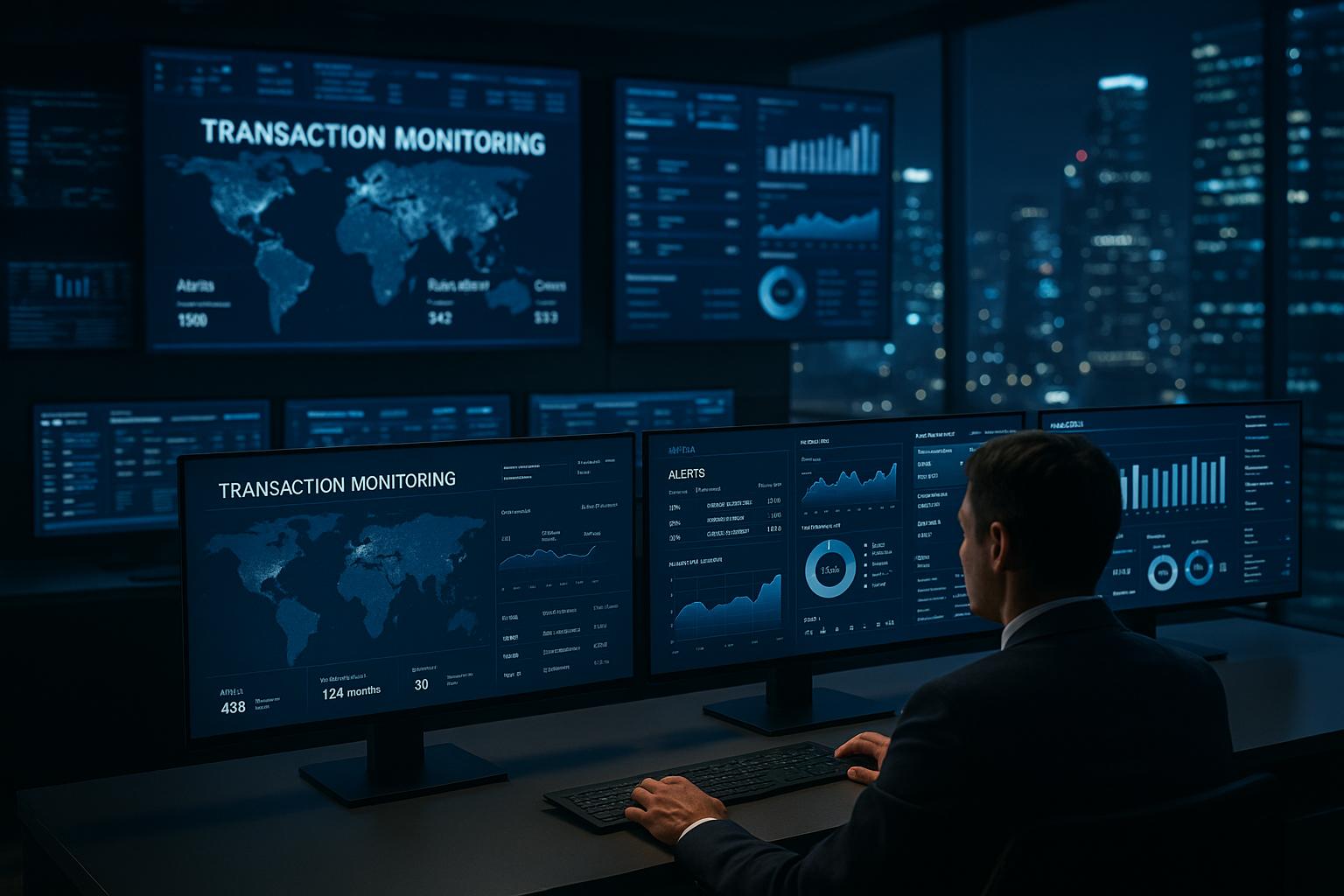
Monitoring means examining transactions against a set of rules to find activity that doesn't fit.
Timing and response are what separate real monitoring from the appearance of it. A system that reviews last month's transactions is telling you about money that has already gone. And a system that flags activity without a defined response is keeping records, not preventing anything.
Good transaction monitoring combines rule types. Value and velocity rules catch volume. Geographic rules catch jurisdictional exposure. Behavioural rules compare a customer against their own history rather than a fixed limit, which is what catches laundering designed to stay under thresholds.
Reporting
When your checks turn up something that looks wrong, you have to report it to your country's financial intelligence unit.
That's the government body that collects reports from banks and other institutions, analyses them, and passes what matters to law enforcement. Nearly every country requires two kinds of reports.
A suspicious transaction report, sometimes called a suspicious activity report, is filed when you have reasonable grounds to suspect a transaction relates to crime. The trigger is suspicion, not proof, and waiting for proof is itself a failure.
A threshold report is filed when a transaction exceeds a set value, whether or not it looks suspicious. Deadlines for both are short, and they differ by country, so check yours rather than assuming.
One rule applies almost universally: you cannot tell the customer. Alerting someone that they've been reported is a criminal offence in most regimes, which constrains what your front-line staff can be told.
Governance, training and records
Most rulebooks require a named officer at senior level, with direct access to the board and genuine independence from commercial pressure. If that person reports to someone whose bonus depends on customer growth, the independence is nominal.
Staff need training that matches their role, and records need keeping for the statutory period in a form you can actually retrieve. The question in an examination is never whether the file exists somewhere. It's whether you can produce it this week.
Why the risk-based approach matters
Every modern AML regime is built on one idea: apply effort in proportion to risk.
This comes from the Financial Action Task Force, known as FATF, the international body that sets AML standards and reviews how countries implement them.
Its 40 Recommendations form the framework almost every national rulebook is built on, and the risk-based approach is Recommendation 1, the foundation everything else sits on.
It means you're not required to treat every customer identically. You're required to understand where your risk genuinely sits and put your resources there. A supervisor's first question is rarely whether you checked everyone the same way. It's how you decided who needed more.
There's a failure mode worth naming. Institutions sometimes respond to risk by refusing whole categories of customers outright, which pushes those people into cash and informal channels where nobody is watching at all. FATF has pushed back on this repeatedly.
FATF President Elisa de Anda Madrazo made the point when the organisation published guidance on financial inclusion:
"Bringing more people into the formal financial sector is crucial to our fight against financial crime, as it reduces the size of the black and informal markets where criminals and terrorists hide their operations."
That reframes what compliance is for. Cutting off risky customers can look like control while making the underlying problem worse. The harder work, and the correct work, is bringing people into a system where their activity is visible.
What actually prevents money laundering
Rules and programmes are the structure. These are the things that make the difference in practice.
- Verify properly at the start: Every later control depends on knowing who the customer is. Weak onboarding means your monitoring has no baseline to compare against, and behavioural detection stops working before you've begun.
- Keep screening after day one: A clean check three years ago tells you nothing about today.
- Watch sequences, not single events: One unusual transaction is usually nothing. A new device, then a change of contact details, then a new payee, then a large transfer, inside a few hours, is an attack. Most systems miss this because each signal sits in a different place.
- Connect your systems: This is the gap we see most often. Institutions have identity checks, screening and monitoring, bought separately, unable to read each other. A sanctions hit that the payment system never sees is not a control. It's a record.
- Tune your rules, and write down why: Thresholds set once and never revisited produce either a flood of pointless alerts or silence. Both are findings. Document every change and the reasoning, because an examiner who finds limits quietly raised will ask, and "the team was overloaded" does not end that conversation well.
- Make reporting easy internally: Staff spot things systems miss. If there's no simple, unembarrassing way for someone to escalate a concern, they won't.
That connection problem is why we built Fraudspect as one platform rather than a set of tools. Identity verification, liveness, screening, adverse media and transaction monitoring share a single intelligence layer, so a signal raised at onboarding is still visible eight months later when the money moves.
One API, one dashboard, one audit trail. We've screened over a million transactions across more than 200 countries, at 98.4% detection accuracy and an average decision in under 200 milliseconds.
Worth saying plainly: no platform makes an institution compliant, ours included. The obligation stays with you. What good tooling does is shorten the distance between something happening and somebody knowing about it.
Where to start
If you're building an AML programme from nothing, the order matters more than the speed.
Write the risk assessment first, even a rough one. Every subsequent decision needs something to point back to, and a programme built without it can't explain itself to a supervisor.
Then fix onboarding, because everything downstream inherits its quality. Real-time verification against authoritative sources, liveness where risk justifies it, and a record of what was checked and who reviewed any mismatch.
Then answer one question honestly. Can your monitoring system see what your onboarding system found? For most institutions, the answer is no, and that gap is larger than any individual rule you could add.
If you want to see what these controls look like running together rather than separately, book a demo with our team. Bring your current control list, and we'll map it against the process above and show you which links are missing.
Understanding AML: How Financial Institutions Detect and Prevent Money Laundering
Money laundering is difficult to detect because criminal funds are deliberately made to look legitimate. Effective AML therefore requires more than verifying customers at onboarding. Financial institutions must continuously screen customers, monitor transactions, connect risk signals and report suspicious activity.